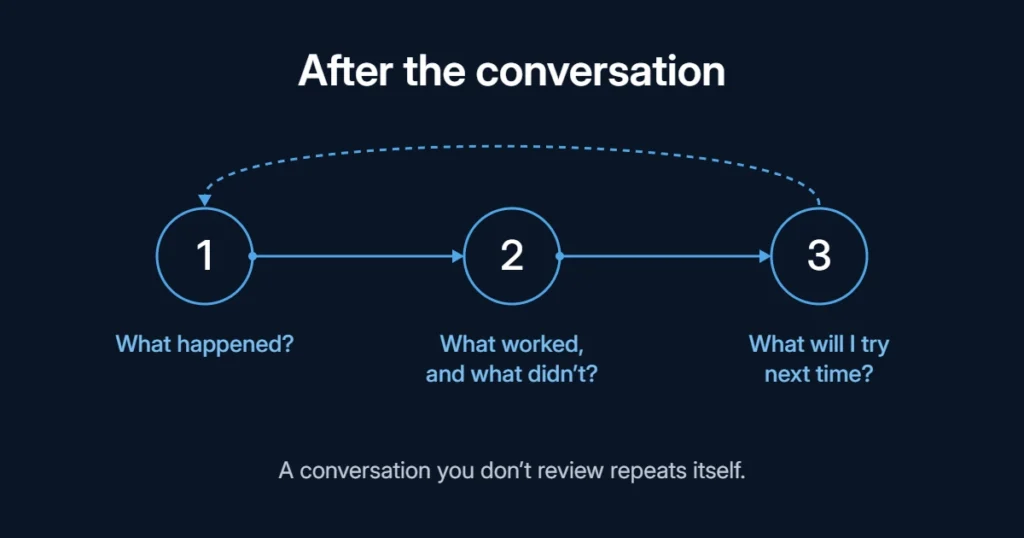
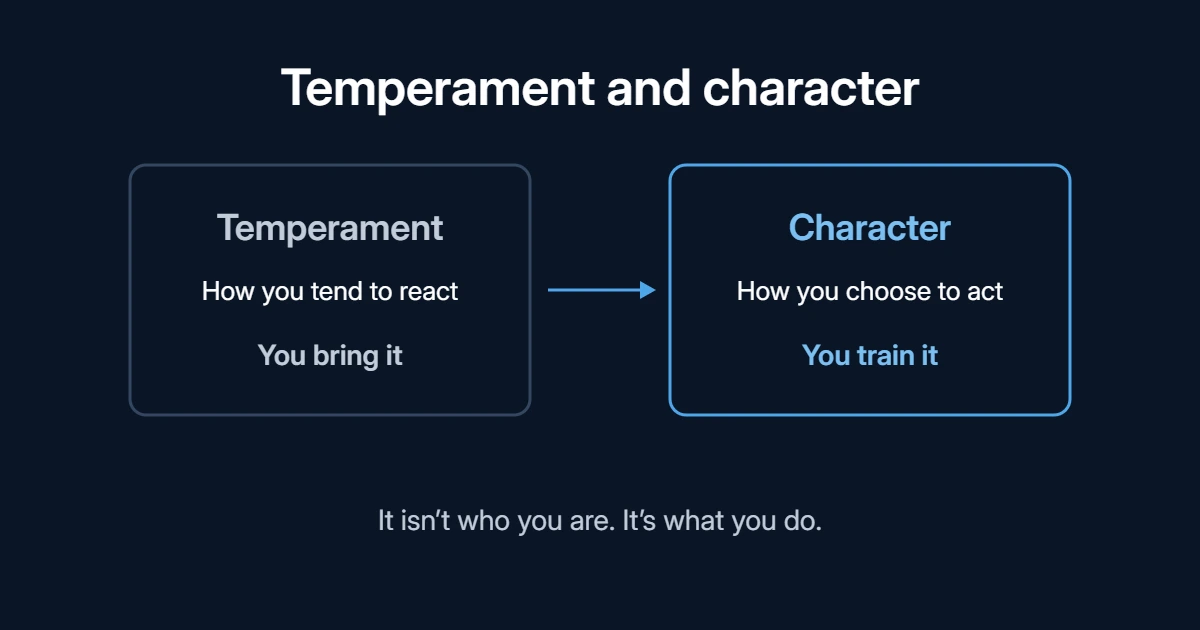
Your temperament decides your first reaction. Your character decides what you do next, and that can be trained.
Yes, you can change how you react in a difficult conversation, though not entirely: your first reaction depends on your temperament, and what you do next depends on your character, which is learnt. In this article I explain the difference between the two, why a difficult conversation is mostly a matter of character and how two very different people can reach the same well-handled conversation.
"That's just the way I am." We've all said it. Some of us go quiet when a conversation gets tense, others jump in before the other person has finished. And when it goes badly, the explanation seems obvious: it's my personality.
It's partly true. I have spent more than thirty years working with management teams, and I have seen very different people learn to handle the same difficult conversations well. None of them changed who they were. All of them changed what they did.
"You don't choose your first reaction. You choose what you do with it."
Before going into the difference, look at how the four communication skills that matter most in a difficult conversation grow: active listening, open questions, recognition and assertiveness. Look at the fourth screen: "A habit: they are part of how I behave". That is character.
Each screen is a skill. It plays on its own, and you can pause it or go through it at your own pace.
Four skills that start as an effort and end up being yours.
In this article
- Temperament: how you tend to react
- Character: how you choose to act
- Why a difficult conversation is a matter of character
- An example: two people, the same conversation
- It isn't who you are, it's what you do
- Conclusion
- References
Temperament: how you tend to react
Temperament is your natural way of reacting: how quickly you get activated, what unsettles you, whether you tend to move closer or protect yourself when things get tense. It appears early in life, is largely inherited and changes little over the years (Cloninger, Svrakic, & Przybeck, 1993).
That's why you don't choose your first reaction in a difficult conversation. If you tend to avoid conflict, you'll feel the urge to soften things. If you tend to confront, you'll feel the urge to get to the point even if the other person hasn't finished. That urge arrives on its own.
Temperament isn't a flaw or a virtue. It's your starting point.
Character: how you choose to act
Character is something else: what you do with that urge. Your habits, your values, how you regulate yourself, what you have learnt to do when a conversation gets complicated. Unlike temperament, it matures with age and develops through learning (Cloninger, Svrakic, & Przybeck, 1993).
The difference matters because it changes the question. "What am I like?" has an answer you can't change much. "What do I do when this happens?" has an answer you can change from the next conversation on.
"Temperament is your starting point. Character is the path you take from there."
Why a difficult conversation is a matter of character
A difficult conversation goes well or badly because of what you do in it: whether you ask or assume, whether you listen to the answer or prepare your own, whether you say what you think or leave it for another day. All of that is behaviour, and behaviour can be learnt.
Temperament decides what will be harder for you. If you tend to avoid, saying the difficult thing clearly will be harder. If you tend to confront, waiting and listening will be harder. But what needs learning is the same for both: a two-way conversation that ends in an agreement. What changes is where each person starts.
An example: two people, the same conversation
Sarah and Tom lead teams in the same company. Both need to talk to someone in their team whose reports are arriving with more and more mistakes.
Sarah: her instinct is to avoid
Sarah has thought about it a lot, but when the moment comes she starts with how well everything is going, skirts around the problem and ends with "anyway, it's just a detail". The other person leaves reassured and unaware that there's a problem.
What Sarah practises is saying what she expects in the first sentence, clearly and respectfully, and then staying quiet.
Tom: his instinct is to confront
Tom goes straight in: "The reports are arriving wrong and this can't go on." The other person gets defensive, Tom pushes back and the conversation turns into an argument about who's right.
What Tom practises is asking before concluding: what's going on with the reports, and listening to the whole answer before proposing anything.
| Person | Instinct | Practises | Reaches |
|---|---|---|---|
| Sarah | Softening until the message gets lost | Saying what she expects in the first sentence | A clear conversation that ends in an agreement |
| Tom | Concluding before listening | Asking and listening before proposing | A clear conversation that ends in an agreement |
Neither of them has changed who they are. Sarah still feels the urge to soften things, and Tom the urge to get to the point. What has changed is what they do after the urge. And with practice, that gets easier every time.
To organise the whole conversation, step by step, the SCORE method divides it into five two-way steps, and I explain it in What is the SCORE method?.
It isn't who you are, it's what you do
Giving yourself a label has a cost: if "that's the way you are", there's nothing to practise. That's why in Xakrom the first stage of the cycle, Know yourself, is for discovering your communication style, and your coach uses it to guide you. It's a starting point, not a diagnosis.
What you work on after that is behaviour: asking, listening, recognising, saying what you think. Things that can be seen in one conversation and repeated in the next.
"A label tells you who you are. A behaviour tells you what you can do tomorrow."
Conclusion
You don't choose your first reaction.
It comes from your temperament, and it isn't a flaw or a virtue: it's your starting point.
What you do next, you do choose.
That's character, and character is learnt.
Everyone starts from a different place.
What's hard for you depends on what you're like. Where you can get to doesn't.
What's your instinct when a conversation gets complicated? It goes better when you've seen it coming, and better still when you've practised it first. That is why I created Xakrom.
Practise this conversation in Xakrom.
Xakrom is in beta. Be one of the first to try it.
References
Cloninger, C. R., Svrakic, D. M., & Przybeck, T. R. (1993). A psychobiological model of temperament and character. Archives of General Psychiatry, 50(12), 975-990. https://doi.org/10.1001/archpsyc.1993.01820240059008