
Five steps to give feedback that looks after both the result and the relationship.
The SCORE method turns feedback into a five-step conversation in which both people speak, both understand and both commit. In this article I show you the method in action, take you through an example step by step and explain the model it comes from.
You know you need to talk to someone in your team. You've thought it through several times, you're clear about what you want to say and you've even chosen your words. The conversation lasts five minutes and ends with "OK, I'll bear that in mind". A week later, nothing has changed.
You weren't short of clarity or courage. What you prepared was a message, and what was needed was a conversation. I have spent more than thirty years working with management teams, and that is the conclusion I have reached: feedback isn't handed over; it is built by two people.
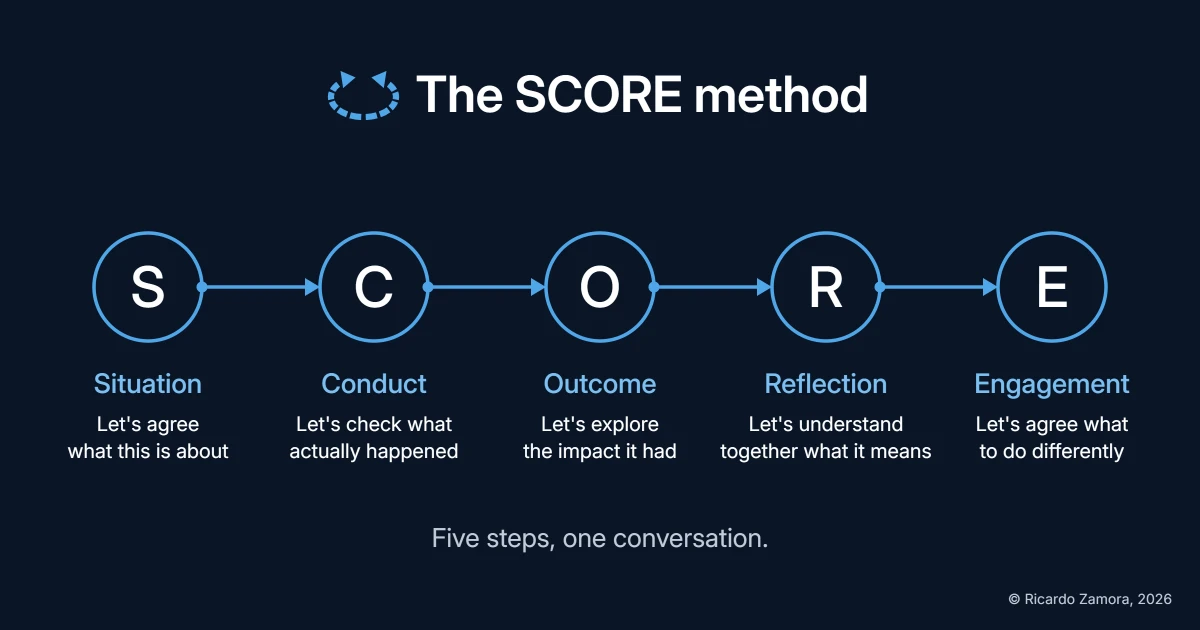
The SCORE method organises that conversation into five steps: Situation, Conduct, Outcome, Reflection and Engagement. Each step is a small agreement between two people, and each agreement prepares the next. It is also the method Xakrom uses to analyse every practice session: the moment it ends, you see what you achieved and what you can try next.
"I try to make myself understood, and also to understand you."
Before going into each step, see it in action. In this conversation you are talking to Khalid, your manager and one of Xakrom's six characters: direct and intense. In a meeting with a client, Khalid settled a delivery date without the two weeks of testing you had just presented, and you want to talk it through with him.
Each screen is a step, with its letter, its name and the phrase that activates it. It plays on its own, and you can pause it or go through it at your own pace.
Five steps, one conversation, and both people speak at every step.
In this article
- Feedback is a conversation, not a message
- The five steps of the SCORE method
- A second example, step by step: the conversation with Katherine
- Why the order matters
- Where SCORE comes from: the Cooplexity model
- Conclusion
- References
Feedback is a conversation, not a message
Feedback exists to show someone what they cannot see in themselves. Joseph Luft and Harrington Ingham captured this in the Johari window as the blind area: what others see in us and we don't. Without feedback, that area doesn't shrink.
The usual way to give it is to prepare the message carefully and deliver it. One person talks and the other listens. But a truth that arrives already worked out tends to meet a closed door: the other person defends themselves, justifies what they did or nods along to get it over with.
People don't change because they are told to change. They change when they understand, when they take part in building the meaning and when the commitment is their own. And that only happens in a real conversation, where both people speak at every step.
That is SCORE's starting point: a two-way conversation that looks after both the result and the relationship. The conversation goes well today, and the relationship is better for tomorrow.
The five steps of the SCORE method
SCORE takes its name from the initials of its five steps. A score is both a result and a piece of written music, and both meanings fit: a well-run feedback conversation is like a score that two people read at the same time and play together, not one after the other.
Each step is activated by a phrase that begins with "let's". That isn't a matter of style: it is the method. Let's agree, let's check, let's explore, let's understand, let's agree. Whoever leads the conversation proposes, and the other person takes part in every step.
| Step | The phrase that activates it | What you agree on |
|---|---|---|
| S · Situation | Let's agree what this is about | The topic, and why it deserves a conversation |
| C · Conduct | Let's check what actually happened | The observable facts, before the emotions |
| O · Outcome | Let's explore the impact it had | The effect it had, and how each of you experienced it |
| R · Reflection | Let's understand together what it means | A shared understanding of what happened |
| E · Engagement | Let's agree what to do differently | What each of you will do from now on |
"Each step is a conversation, not a turn to speak."
A second example, step by step: the conversation with Katherine
With Khalid, the conversation went upwards: you were talking to your manager. Here is a second example in the other direction, with someone in your team, and this time step by step.

Katherine
Katherine is another of Xakrom's six characters. Results-driven and competitive. Opinions aren't enough for her; she looks for evidence of success.
In this example, Katherine runs one of your team's projects. At last week's progress meeting, Daniel explained why his part was running late, and Katherine answered him in front of everyone: "No excuses, just results."
You need to talk to her. This is how the conversation would go.
S · Situation: let's agree what this is about
You: I wanted to talk to you about last week's progress meeting. I think it affects the whole project. Is now a good time?
Katherine: Now's fine. I wanted to talk about the project too: we're running late.
Agreed: the topic, and that it deserves a conversation. Katherine adds her own concern, so the conversation starts with two reasons to happen instead of one.
C · Conduct: let's check what actually happened
You: When Daniel explained why his part was running late, you replied "No excuses, just results" and moved on to the next item.
Katherine: Yes, I said that. We'd been waiting three weeks for that part.
Agreed: what happened, in the words that were used. Katherine doesn't dispute it: she explains it. From here on, nobody has to defend their version of events.
O · Outcome: let's explore the impact it had
You: At this week's meeting nobody raised a single problem, and I've heard about two more delays through the grapevine. It worries me to find out late about what isn't going well.
Katherine: I didn't know about the other two delays. What I saw was a project that had stalled. I wanted it moving, not people keeping quiet.
Agreed: the effect it had, seen from both sides. Katherine finds out about two delays she didn't know about, and you understand what she was after. Nobody has accused anybody, which is why the conversation can carry on.
R · Reflection: let's understand together what it means
You: What do you make of all this?
Katherine: I wanted to go faster, and all I've got for it is finding out later. If problems aren't raised, they don't get solved.
Agreed: what it all means. This is the most important step in SCORE, and the one that depends most on the others: with the facts and the impact on the table, understanding follows.
E · Engagement: let's agree what to do differently
You: What could we do differently from now on?
Katherine: When someone brings me a delay, the first thing I'll ask is what they need to unblock it. I'll talk to Daniel today. And if you see me cutting someone off, tell me after the meeting.
You: Done. Let's review it in two weeks.
Agreed: what each of you will do from now on. Katherine changes her first question when a delay comes up, and you commit to telling her. The commitment belongs to both of you, because the conversation did too.
The whole conversation takes a few minutes. Nobody has made a speech, and both of you leave with something to do.
Why the order matters
Each step leaves something agreed, and the next one rests on it: first the context, next the facts, after that the impact, then the understanding and, finally, the agreement. The order isn't a whim. It is what lets each step stand on firm ground: impact is easier to hear once the facts are agreed, and a commitment carries more weight when it grows out of a shared understanding.
SCORE is not a script. You don't need to say the phrases word for word, and a real conversation doesn't always move in a straight line: sometimes a step is settled in one sentence, and sometimes you need to go back. What matters is that each step is agreed before you move on to the next. The conversation moves forward because someone leads it, and leading it is a skill you learn by practising.
"An agreed step is the ground the next one stands on."
Where SCORE comes from: the Cooplexity model
SCORE comes from the Cooplexity model, which I published in 2020 after research with more than 50 teams, 600 participants and 12 sectors (Zamora, 2020).
Cooplexity describes how trust develops in teams that work in complex environments, and it puts the interaction between people at the centre of that development. Not the content that is passed on. Not the skill of whoever is communicating. The quality of the interaction.
SCORE brings that idea into a single conversation, and draws on two of its steps:
- The second, relationship management: there is no cooperation without a bond, and the bond starts with listening.
- The fifth, change management: assertiveness, which lets you express disagreement clearly and respectfully, without attacking the other person or giving in to them.
That is why, at every step of SCORE, listening counts as much as speaking.
A well-run feedback conversation leaves more than an agreement: it leaves more trust than there was before. And that trust is what makes the next conversation easier.
"Trust isn't passed on. It is built in every conversation."
Conclusion
Feedback isn't handed over. It is built by two people.
Preparing what you want to say is necessary, but not enough. What changes things is what gets agreed along the way: the topic, the facts, the impact, the meaning and the commitment.
Order is what makes agreement possible.
Each step prepares the next. When the order is respected, the other person reaches the reflection with the facts agreed and the impact acknowledged, and the conclusion is theirs.
The person giving feedback commits too.
A commitment from both sides turns the conversation into a starting point, not a verdict.
In Xakrom you practise these conversations out loud with six characters, Khalid and Katherine among them, and the moment you finish you see what you achieved and what you can try next, with the SCORE method.
Which feedback conversation is waiting for you? It goes better when you have practised it first. That is why I created Xakrom.
Practise this conversation in Xakrom.
Xakrom is in beta. Be one of the first to try it.
References
Luft, J., & Ingham, H. (1955). The Johari Window: A Graphic Model of Interpersonal Awareness. Proceedings of the Western Training Laboratory in Group Development. Los Angeles: UCLA.
Zamora, R. (2020). Cooperación en complejidad: Cooplexity, un modelo de colaboración en complejidad en tiempos de incertidumbre y cambio [Cooperation in complexity: Cooplexity, a model of collaboration in complexity in times of uncertainty and change]. Ricardo Zamora. ResearchGate