
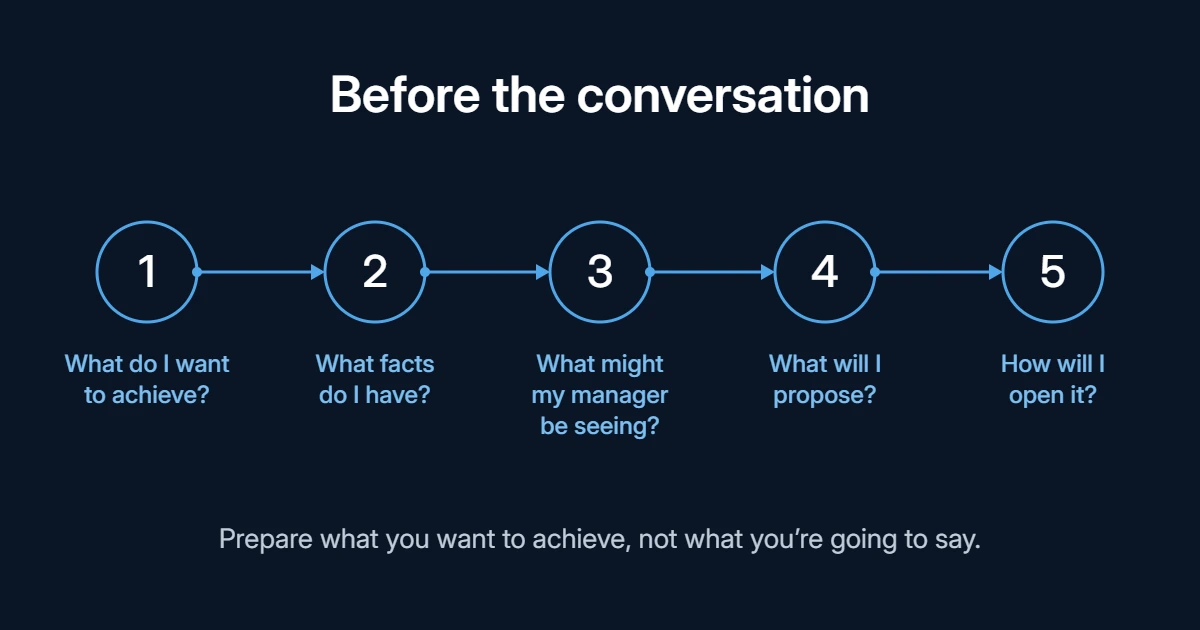
Preparing isn't rehearsing what you'll say: it's arriving clear about what you want to achieve, and ready to listen.
You can prepare a difficult conversation with your manager with five questions: what you want to achieve, what facts you have, what your manager may be seeing, what you'll propose and how you'll open it. In this article I take you through them one by one, walk you through an example and show you the four skills that matter most in that conversation.
You've been turning it over for days. Your manager has made a decision that affects you and you don't agree with it: a deadline that doesn't add up, a priority that has changed without explanation, a workload that no longer fits. You know you need to tell them. And every day you find a good reason to leave it until tomorrow.
It isn't a lack of courage. Talking upwards is harder because there is more at stake: the person you need to talk to is the one who sets your priorities and assesses your work. I have spent more than thirty years working with management teams, and what I see most often isn't a conversation that went badly: it's a conversation that never happened.
The good news is that this conversation can be prepared. Not so that you arrive with it written out, but so that you arrive with clear ideas and a mind free to listen.
"What goes unsaid has consequences too."
Before going into the preparation, look at the four communication skills that matter most when you talk to your manager: active listening, open questions, recognition and assertiveness. None of them is a talent you're born with: all four grow with practice.
Each screen is a skill. It plays on its own, and you can pause it or go through it at your own pace.
Four skills, and none of them depends on who holds the title.
In this article
- Why talking upwards is harder
- Five questions to prepare it
- An example: the conversation with Ingrid
- Preparing isn't armouring yourself
- Conclusion
- References
Why talking upwards is harder
When Frances Milliken, Elizabeth Morrison and Patricia Hewlin asked professionals about the issues they didn't dare raise with their bosses, two reasons came up again and again: the fear of being seen in a negative light and the fear of damaging the relationship (Milliken, Morrison, & Hewlin, 2003).
Both fears are reasonable, and both lead to the same place: silence, or letting it all out at once on the day you can't take any more. Neither path protects the relationship. Silence empties it, and the outburst breaks it.
There is a third way, and it's the prepared conversation. It isn't about winning an argument with your manager, but about giving them information they don't have yet and deciding together what to do with it. Put like that, it stops being a confrontation and becomes part of your job.
Five questions to prepare it
Before you ask for the conversation, spend ten minutes answering these five questions in writing. You don't need more.
1 · What do I want to achieve?
One sentence, and a concrete one. "For them to know how I feel" isn't an objective; "to leave with a decision on which project slips" is. If you don't know what you want to achieve, your manager won't either, and the conversation will end up as letting off steam.
2 · What facts do I have?
Separate what happened from what you think about what happened: dates, figures, decisions, words that were said. The facts are the ground you can share. Your interpretations, for now, are yours alone.
3 · What might my manager be seeing that I'm not?
Your manager has information you don't: what's being asked of them, what was decided in a meeting you weren't in, what's weighing on another team. Write down two or three possibilities. Not to concede the point in advance, but to arrive with curiosity instead of a verdict.
4 · What will I propose, and where can I give?
Arrive with at least one proposal. A conversation that only brings a problem leaves all the work to the other person; one that brings a problem and a possible way out invites them to build. And decide beforehand where you can give: a proposal that allows no change is an ultimatum.
5 · How will I open it?
Ask for the time: don't improvise it in a corridor. And prepare only the first sentence, with the topic and why it matters to you. From there on, the conversation isn't yours any more: it belongs to both of you.
| Question | What you bring prepared |
|---|---|
| What do I want to achieve? | A concrete objective, in one sentence |
| What facts do I have? | What happened, separated from what you think |
| What might my manager be seeing? | Two or three possibilities, so you arrive curious |
| What will I propose? | A possible way out and the room you have to give |
| How will I open it? | The time agreed and the first sentence |
"If you don't know what you want to achieve, your manager won't either."
An example: the conversation with Ingrid

Ingrid
Ingrid is one of Xakrom's six characters. Meticulous and committed. She spots inconsistencies and expects the same rigour from you.
In this example, Ingrid is your manager. On Monday she asked you to take on the launch for a new client, with the same deadline as the quarterly report you're already working on. The two don't fit into the same two weeks, and you want to tell her.
This is your preparation:
- What I want to achieve: to leave with a decision on what gets delivered first.
- What facts I have: the report needs eight days of work and the launch, ten. There are ten working days left.
- What Ingrid might be seeing: perhaps the new client is a priority coming from higher up, or perhaps she's counting on someone in the team for the report.
- What I'll propose: delivering the report on time and starting the launch with a shorter first phase. I can give on the order, not on doing both in full at the same time.
- How I'll open it: by asking her for half an hour first thing tomorrow.
And this is how the conversation begins:
You: Ingrid, I wanted to talk to you about the new client's launch and the quarterly report. As they're planned, I can't do both to the standard you expect, and I'd rather tell you now than in two weeks' time.
Ingrid: I'm listening. Where exactly is the problem?
You: In the days. The report needs eight and the launch ten, and we have ten. Before I propose anything: is there something about the client's priority that I'm not seeing?
Ingrid: Yes. The leadership team wants the first part of the launch before the end of the month. The report has more room than it seems.
Look at what the preparation has done. The objective gave you your first sentence. The facts avoided an argument about whether "it's a lot of work". And the third question, about what Ingrid might be seeing, brought to the table the information that changes everything.
With that information your proposal changes, and it's right that it does: the order is reversed. What you had prepared wasn't a script. It was a starting point.
From here on, the conversation is led. The SCORE method organises it into five two-way steps, and I explain it in What is the SCORE method?.
Preparing isn't armouring yourself
Preparation carries a risk: arriving so prepared that you no longer listen. If you have every sentence written down and an answer to every objection, the conversation turns into a defence, and your manager notices.
That's why there are three things it's best not to prepare: the full script, the conclusion and the other person's answer. The conclusion is built by the two of you, and your manager's answer is exactly what you're going there to hear.
In the Cooplexity model, relationship management is the second step in developing trust: there is no cooperation without a bond, and the bond starts with listening (Zamora, 2020). With your manager too.
"Prepare what you want to achieve, not what you're going to say."
Conclusion
What goes unsaid has consequences too.
Silence doesn't protect your relationship with your manager: it empties it. A prepared conversation is the most respectful way to tell them what you think.
You prepare it with five questions, not with a speech.
Your objective, the facts, what the other person sees, your proposal and the first sentence. Ten minutes is enough.
Arrive ready to listen.
The information you're missing is in your manager's hands, and the conversation is where it comes out.
Which conversation with your manager is waiting for you? It goes better when you've prepared it, and better still when you've practised it first. That is why I created Xakrom.
Practise this conversation in Xakrom.
Xakrom is in beta. Be one of the first to try it.
References
Milliken, F. J., Morrison, E. W., & Hewlin, P. F. (2003). An exploratory study of employee silence: Issues that employees don't communicate upward and why. Journal of Management Studies, 40(6), 1453-1476. https://doi.org/10.1111/1467-6486.00387
Zamora, R. (2020). Cooperación en complejidad: Cooplexity, un modelo de colaboración en complejidad en tiempos de incertidumbre y cambio [Cooperation in complexity: Cooplexity, a model of collaboration in complexity in times of uncertainty and change]. Ricardo Zamora. ResearchGate