
The feedback that changes something isn't the best-worded: it's the one that ends in an agreement the other person feels is theirs.
For feedback to someone in your team to change anything, you need to avoid three traps, the sandwich, the judgement and the monologue, and not settle for the first "yes". In this article I explain why so much feedback comes to nothing, show you the three traps and walk you through a conversation where the "yes" comes too soon.
You did it well. You chose the moment, you talked in private, you said what you had to say without raising your voice. The other person listened, nodded and agreed with you. And two weeks later, nothing has changed.
It isn't bad will, theirs or yours. I have spent more than thirty years working with management teams, and the feedback conversation I see most often isn't the one that ends badly: it's the one that ends well and changes nothing.
The difference isn't in how you say what you have to say. It's in what happens after you've said it.
"Being told you're right isn't the same as reaching an agreement."
Before going into the traps, meet Xakrom's six characters. Each of them reacts in their own way, like the people in your team, and the same feedback doesn't land the same way with all of them. Astrid, from the example in this article, is the fifth.
Each screen is a character. It plays on its own, and you can pause it or go through it at your own pace.
Six people, six ways of taking in what you tell them.
In this article
- Why so much feedback changes nothing
- Three traps that turn feedback into a formality
- An example: the conversation with Astrid
- A yes isn't an agreement
- Conclusion
- References
Why so much feedback changes nothing
We take it for granted that feedback, if it's honest, helps. Not always. When Avraham Kluger and Angelo DeNisi reviewed hundreds of studies on the effect of feedback on performance, they found that more than a third of the time it made performance worse (Kluger & DeNisi, 1996).
Feedback fails when the other person stops looking at what they did and starts looking at themselves: whether they're good at their job, what you think of them, how to get out of the conversation. From that point on they aren't learning anything. They're defending themselves, or waiting for you to finish.
That's why what you decide before you open your mouth matters as much as what you say: what you're going to talk about, in what words, and how much room you'll leave the other person.
Three traps that turn feedback into a formality
1 · The sandwich
Praise, the difficult part, then more praise, so it doesn't hurt. The problem is that the other person soon learns the recipe: when they hear the first compliment, they're already waiting for the "but". And what you wanted to say ends up hidden between two sentences they don't believe.
What works better is to say it clearly and respectfully, without the wrapping. Recognition, when it's true, deserves a conversation of its own.
2 · The judgement instead of the fact
"You're not proactive enough" is an opinion about the person, and an opinion gets argued with. "The analysis arrived on Thursday and it was due on Tuesday" is a fact, and a fact is something you can look at together.
The more concrete, the better: what happened, when, and what effect it had. A judgement puts the other person on the defensive; a fact invites them to explain.
3 · The monologue
You've prepared the conversation so thoroughly that you deliver it all in one go. The other person listens, nods and leaves. You did the talking, and only you.
What works better is to stop early and ask. An open question, one that can't be answered with a yes or a no, turns a message into a conversation.
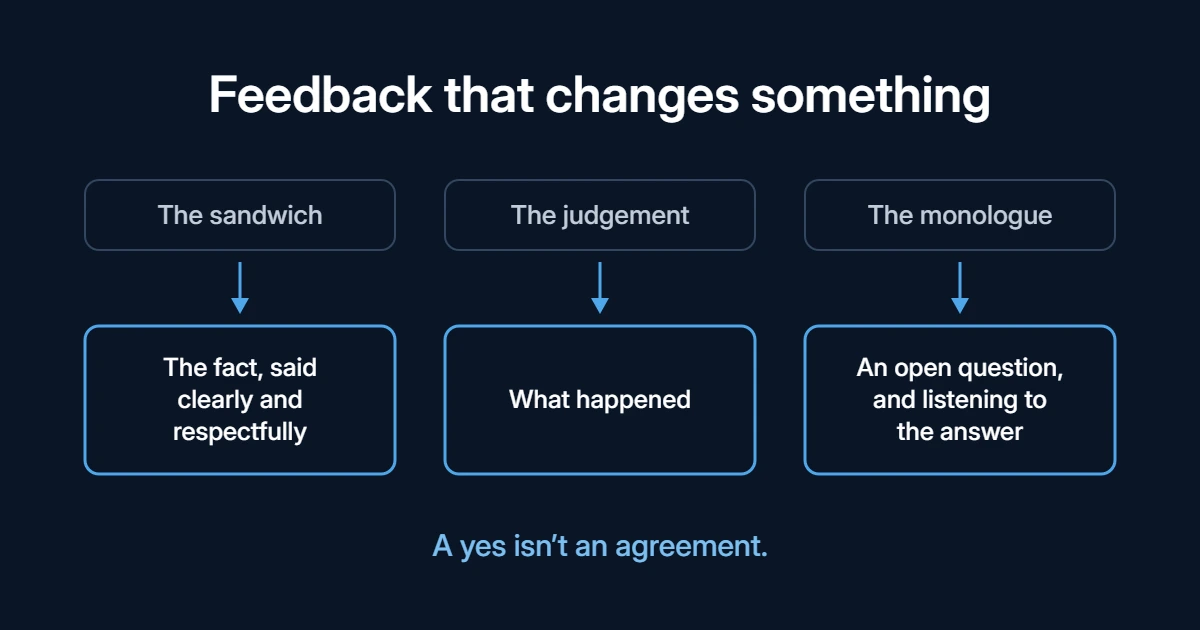
| Trap | What works better |
|---|---|
| The sandwich: the difficult part, between two compliments | The fact, said clearly and respectfully |
| The judgement: "you're not proactive enough" | What happened: "the analysis arrived on Thursday" |
| The monologue: you talk, the other person nods | An open question, and listening to the answer |
"A judgement gets argued with. A fact can be looked at together."
An example: the conversation with Astrid

Astrid
Astrid is one of Xakrom's six characters. Warm and conciliatory. She agrees easily; what she really thinks stays inside.
In this example, Astrid is in your team. The analysis she was due to deliver to a client on Tuesday arrived on Thursday, without warning, and the client asked for it twice. It's the second time this quarter. You've avoided the three traps: no sandwich, the fact, and ready to ask.
You: Astrid, I wanted to talk to you about the analysis delivery. Have you got a moment now?
Astrid: Of course, go ahead.
You: The analysis arrived on Thursday and it was due on Tuesday. You didn't let us know, and the client asked for it twice. It's the second time this quarter.
Astrid: You're right, I'm sorry. It won't happen again.
This is where many feedback conversations end. You have an apology and a promise, and it seems everything has been said. But you don't know what happened, so you don't know what's going to change either.
You: Thank you for saying that. Before we finish, what happened that week?
Astrid: Marketing asked me for two urgent things and I didn't know how to say no. I thought I could manage everything.
You: And what would have helped you?
Astrid: Knowing I can tell you I'm stretched without it looking as if I'm not up to the job.
You: You can. Here's a suggestion: when you see a delivery is at risk, tell me as soon as you know. And whatever other teams ask of you, we'll prioritise together.
Astrid: Done. On Monday I'll show you what I've got on this week.
The first "yes" closed the conversation. The question opened it. And what has come out isn't a promise not to do it again, but a concrete agreement, with something to do on each side.
To lead the whole conversation, step by step, the SCORE method organises it into five two-way steps, and I explain it in What is the SCORE method?.
A yes isn't an agreement
A "yes" that comes too soon often means something else: that the other person wants the conversation to end. They're uncomfortable, they don't want to argue with you, or they haven't yet thought about what happened. It can happen with anyone in your team.
That's why, when agreement comes very quickly, one more question is worth it: what happened, what would have helped, what each of you will do from now on. If the answer changes nothing, you've lost a minute. If it changes something, you've won the whole conversation.
In the Cooplexity model, change management rests on assertiveness: saying what you think clearly and respectfully, and letting the other person do the same (Zamora, 2020). An agreement only belongs to both of you when both of you have been able to say what you thought.
"When the yes comes too soon, one more question is worth it."
Conclusion
Feedback doesn't always help.
It works when the other person looks at what happened, not when they have to defend themselves.
No sandwich, with facts and with questions.
Say the difficult thing clearly, talk about what happened rather than what the person is like, and leave room for them to speak.
A yes isn't an agreement.
An agreement is concrete, has something to do on each side, and the other person feels it is theirs.
Is there someone in your team you need to have this conversation with? It goes better when you've thought it through, and better still when you've practised it first. That is why I created Xakrom.
Practise this conversation in Xakrom.
Xakrom is in beta. Be one of the first to try it.
References
Kluger, A. N., & DeNisi, A. (1996). The effects of feedback interventions on performance: A historical review, a meta-analysis, and a preliminary feedback intervention theory. Psychological Bulletin, 119(2), 254-284. https://doi.org/10.1037/0033-2909.119.2.254
Zamora, R. (2020). Cooperación en complejidad: Cooplexity, un modelo de colaboración en complejidad en tiempos de incertidumbre y cambio [Cooperation in complexity: Cooplexity, a model of collaboration in complexity in times of uncertainty and change]. Ricardo Zamora. ResearchGate