
Really helping isn't saying what the other person wants to hear: it's telling them what they need to know, in a way they can use.
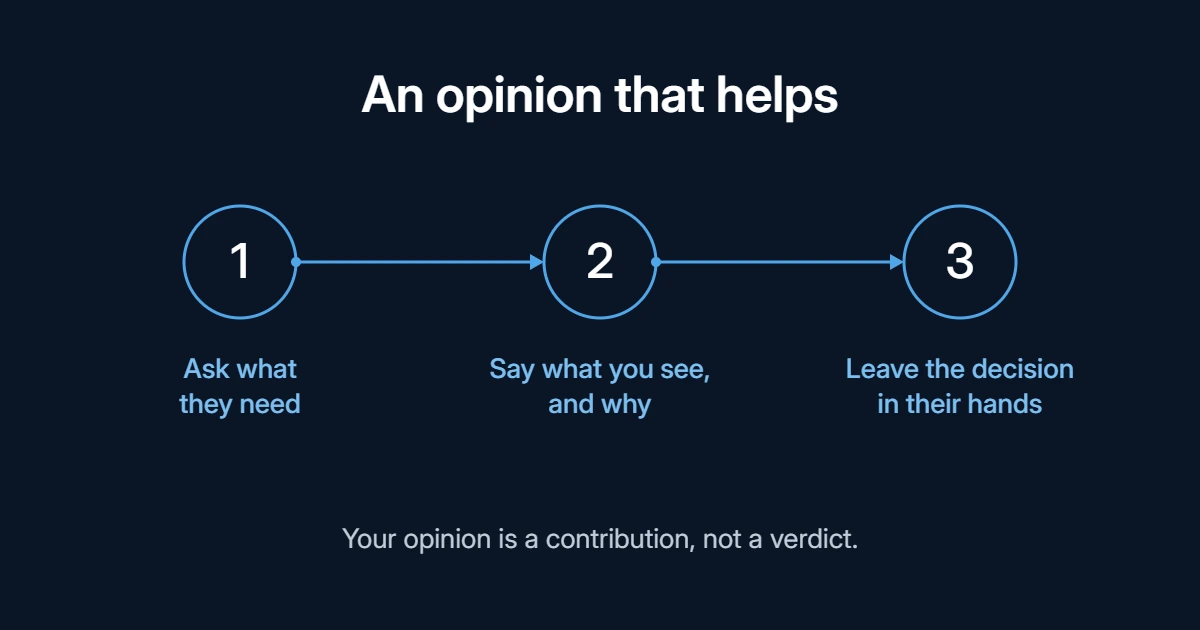
When someone you trust asks for your opinion, you help more if you first ask what they need, say what you see with facts and leave the decision in their hands. In this article I explain why honesty is harder between peers, suggest three steps and walk you through a conversation with a colleague who is about to present a proposal.
A colleague shows you the project they've been working on for weeks and asks: "What do you think? Be honest." You read it and see a problem. And in that moment it feels as if you have to choose between the truth and the relationship.
It's a false choice. I have spent more than thirty years working with management teams, and I have seen many projects that everyone thought were weak and nobody dared to question. Not for lack of trust: out of too much care.
Honesty isn't the opposite of the relationship. Done well, it's what makes it stronger.
"Keeping quiet to protect the relationship has a price too."
Before going into the steps, look at how the four communication skills that matter most in this conversation grow: active listening, open questions, recognition and assertiveness. The fourth is the one this article is about: giving your opinion firmly and without offending.
Each screen is a skill. It plays on its own, and you can pause it or go through it at your own pace.
Four skills, and the last one is what this conversation asks for.
In this article
- Why honesty is harder between peers
- Three steps to make your opinion help
- An example: the conversation with Lucas
- Trust is built by telling the truth
- Conclusion
- References
Why honesty is harder between peers
With someone in your team, giving feedback is part of your role. With your manager, at least you know that raising a problem is part of your job. Between peers, no role obliges you: if you say what you think, it's because you choose to. And what you're risking is a relationship that matters to you.
That's why the temptation is to soften it until nothing is left: "it's really good", "maybe I'd change a detail or two". Kim Scott has a name for this: ruinous empathy, keeping quiet about something important so as not to hurt (Scott, 2017). It seems kind, and it leaves the other person alone with a problem you had already seen.
They asked for your opinion because they trust you. An opinion that says nothing doesn't repay that trust.
Three steps to make your opinion help
1 · Ask what they need
"What do you think?" can mean very different things. Perhaps they want to decide whether to go ahead. Perhaps they've already decided and want it to go better. Perhaps they just need some confidence before presenting it. Before you give your opinion, ask: the same opinion helps or gets in the way depending on what they want it for.
2 · Say what you see, and why
Not "it won't work", but the specific point that worries you and the reason. A sweeping judgement forces the other person to defend all their work; a specific point gives them something they can fix. And if something works, say that too, and specifically: not as wrapping, but because it's information as well.
3 · Leave the decision in their hands
It's their project. Your opinion is a contribution, not a verdict. Once you've said what you see, ask what they'll do with it. The conclusion being theirs is what makes them use it.
| Instead of… | Try… |
|---|---|
| Giving an opinion without knowing what for | Asking what they need |
| "It's great" or "it won't work" | What you see, specifically, and why |
| "I wouldn't present it" | Asking what they'll do with what you've said |
"Your opinion is a contribution, not a verdict."
An example: the conversation with Lucas

Lucas
Lucas is one of Xakrom's six characters. Enthusiastic and creative. He connects ideas and people; easy to open, hard to close.
In this example, Lucas is a colleague from another department you get on well with. He has designed a cross-department mentoring programme and is presenting it to the leadership team on Friday. He shows it to you and asks for your opinion. You see a problem: the programme asks each manager for four hours a month, and nobody has asked them.
Lucas: So, what do you think? And be honest, I'm presenting it to the leadership team on Friday.
You: I'll tell you. First, what do you need from me: help deciding whether to present it, or help making it go better on Friday?
Lucas: I'm presenting it either way. I want it to go well.
You: Then I'll tell you what I see. The idea of bringing departments together is very good: it's exactly what's missing. What worries me is the time. The programme asks each manager for four hours a month, and I can't see that anyone has asked them. If the leadership team raises that, the proposal stops there.
Lucas: Ouch. You're right, I took that for granted.
You: What could you do before Friday?
Lucas: Talk to two or three managers this week. If they say yes, I'll mention it in the presentation. If not, I'll start with a smaller pilot.
You: That sounds like a good plan. And if you like, I'll listen to your presentation on Thursday.
Look at what happened. The first question changed the opinion that was needed: not whether to present it, but how to make it go better. The concern came across specifically and with its reason, so Lucas could do something with it. And the decision stayed with him, and he left with a plan of his own rather than a list of what was wrong.
If the conversation gets harder and turns into a real feedback conversation, the SCORE method organises it into five two-way steps, and I explain it in What is the SCORE method?.
Trust is built by telling the truth
It's easy to think that trust between two people means never saying anything uncomfortable. It's the other way round: trust is being able to say it, and the relationship coming out stronger.
In the Cooplexity model, relationship management is the second step in developing trust: there is no cooperation without a bond, and the bond starts with listening (Zamora, 2020). That's why the three steps begin and end with a question.
The next time that person asks for your opinion, they'll know that what you say is worth hearing.
"Trust isn't never saying anything uncomfortable. It's being able to say it."
Conclusion
Keeping quiet has a price too.
An opinion that says nothing leaves the other person alone with a problem you had already seen.
Ask before you give your opinion.
Knowing what they want it for decides which opinion helps them.
Your opinion is a contribution, not a verdict.
Say what you see and why, and let the decision be theirs.
Who has asked for your opinion lately? It goes better when you've thought it through, and better still when you've practised it first. That is why I created Xakrom.
Practise this conversation in Xakrom.
Xakrom is in beta. Be one of the first to try it.
References
Scott, K. (2017). Radical Candor: Be a Kick-Ass Boss Without Losing Your Humanity. St. Martin's Press.
Zamora, R. (2020). Cooperación en complejidad: Cooplexity, un modelo de colaboración en complejidad en tiempos de incertidumbre y cambio [Cooperation in complexity: Cooplexity, a model of collaboration in complexity in times of uncertainty and change]. Ricardo Zamora. ResearchGate